
Once we reach age 60, most of us can expect to live another two decades, according to the Center for Disease Control. Life expectancy for those over 65 is 18-21 years (source www.cdc/nchs/fastats). In other words, we can expect to spend a full 25 percent of our lives “in retirement.” In those stark, statistical terms, the challenge becomes clear: how do you spend those 20 years, seemingly a long time to be “retired”? Will it be an endless repetition of scanning the obits, counting our steps monitored by fitness watches, and worrying about our next blood draw to check cholesterol levels? We will, in these years, attend more funerals than weddings, more doctor’s appointments than kids’ sporting events, and see more advertising directed at being healthy and young, instead of being graceful and mature. These years do not have to be slow and dull, but how do we achieve that? The answer comes down to three A’s: awareness, activity, and association.
Awareness, but not Obsession
No one likes the person who constantly talks about his health– or his golf game for that matter. However, being aware of our health and physical abilities is reasonable, at any age. “When starting a fitness program expectations can be a bit out of whack, no matter the age of the person,” says Donna Ryan, a pilates and strength trainer from Oregon, Ohio. Ryan, who is 73, teaches many classes, primarily focussed on older, maturing adults.  “My whole classroom is filled with people who are 60 plus. They have a whole host of problems, including all the ‘itises’ like arthritis, bursitis, etc. The important thing is to not focus on these complaints, but rather to be aware of them and work with existing capabilities. If we have someone with a hip or knee issue we work with that, instead of making it an excuse.” This awareness keeps us active and independent, Ryan continues. “There is no question that functional movement and strength are important, giving us confidence to be independent and self-assured.”
Activity, beyond Bingo
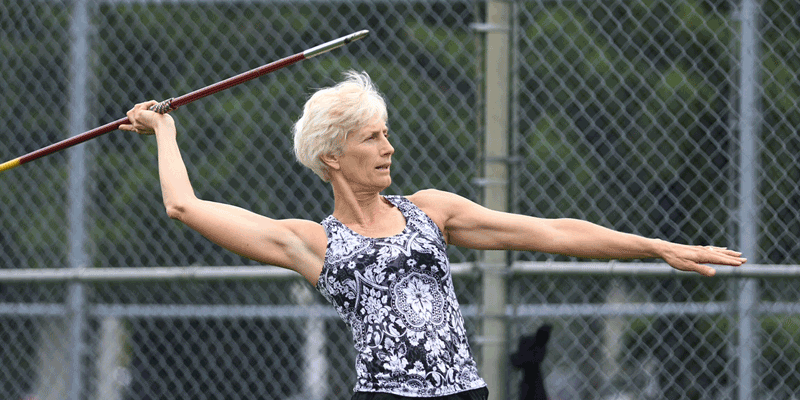
Mary Chris Kay is a swim instructor at Ft. Meigs YMCA. The 63-year-old Perrysburg resident is a big proponent of activity. “I’ve been teaching swimming for about eight years. I didn’t even start trying to swim competitively until I was 30. I used to teach water aerobics as well but felt people weren’t progressing with fitness, so I started a lap swimming class.” Retired, with nine children and 30 grandchildren, Kay has been quite successful with the local swim program. In the last six years over 25 of her class members have competed in the Senior Olympics, a competitive athletic program for people over 50. “This year we have six going to the national competition,” she explains with pride. “Many of these people had very little swim experience when they started.” A big advocate of conditioning, Kay also finds ways to maintain interest. “Having a goal is really important. It can be something as simple as achieving a certain distance total over a year. We have 100-mile swim clubs, for instance.” Beyond the goals, there is also the benefit of being involved with others.“The way to reach a goal is to be around other people. We have swimmers ages 14 to 70 in our classes, many of them swimming side by side. They offer each other encouragement to achieve the goals. Competing in something like the Senior Olympics is a great way to stay interested.” 
Association by Choice
Being an “active adult” is becoming less and less cliché as more people enter their retirement years. Terry McCauley, a 71-year-old accountant from Toledo is a prime example. In the summer of 2016 he was recognized as a Distinguished Toastmaster by Toastmasters International, the result of over 50 evaluated public speeches and extensive leadership projects. “I didn’t even join Toastmasters until I was 60,” says McCauley. “It was highly supported at Consumers Energy, the company I retired from. Even though being a Distinguished Toastmaster is the ultimate accolade of the organization, that wasn’t my focus. I just wanted to be better at leadership and public presentation.” McCauley continued to attend Toastmasters after retirement. “I loved the fact that I was being challenged to take on new roles, especially in leadership. I admit that many of the things they wanted me to do were way outside of my comfort zone. However, I found out not only that I had the ability to grow and learn but also that I really wanted to.” Although the Distinguished Toastmaster is an important credential for those still in active professional life, it is the organization itself that energizes McCauley, who now serves as one of Toastmaster International’s division directors. “The more I am around people and the more active I am the better I feel. I know some people my age sit around and feel down about life. It is really hard to have a bad attitude when you are around positive people.”
Attitude Adjustment
Awareness, activity, and association all lead to a single unifying factor surrounding adults who are enjoying their post work years: a positive attitude. “It is so common for people to think ‘I can’t do that,’ ” claims Kay, referring to her swim students. “They come into a class and think that maybe they will just get a bit healthier. However, with the right attitude, good coaching, and being around other people they find themselves achieving amazing results, often beyond their expectations. None of our national competitors had any competition experience prior to coming to our classes.”