

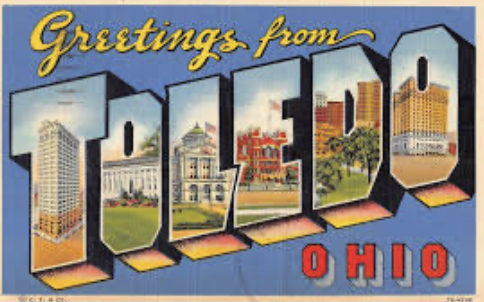

If you’ve ever been anywhere in Toledo, you’ve likely heard the nickname The Glass City. Whether it’s The Glass City Center, The Glass City Riverwalk, The Glass City Marathon, or referring to the Toledo Art Museum’s Glass Pavilion, the nickname is everywhere and rightfully so. Toledo has certainly earned the title, and while many Toledoans know that’s our city’s nickname, how many know the history behind it?
Libbey Glass Factory

Toledo’s involvement in the glass industry is the main reason behind the city’s nickname. In the late 1800s Toledo was one of the largest glass manufacturers in the country which came about when Edward Libbey moved his glass factory, the New England Glass Factory, from Massachusetts to Toledo in 1888. Libbey decided on Toledo for a few reasons such as the natural elements like the Maumee River connecting to the Great Lakes, cheap natural gas, and a large amount of high silica sand which is a primary ingredient in glassmaking. Additionally Toledo provided a significant railroad hub and a large population of boys that could be staffed at the facility. In 1892 Libbey renamed his glass company The Libbey Glass Company. During the early years in Toledo, The Libbey Glass Company focused primarily on making brilliant cut glass which is heavy lead glass tableware with lots of geometric or floral patterns all cut by hand.
Despite the excitement of the new glass company in Toledo, there were some issues that arose such as problems with the equipment, especially the furnace which is essential for creating glass pieces, and a lot of the workers were not happy with the adjustment from the bustling city life they knew to the quiet midwest. So Libbey went to Pennsylvania and West Virginia to find new skilled glass blowers to hire. One of which was Michael J. Owens who started as a glassblower, but became the plant superintendent very quickly.
Flat glass production
While The Libbey Glass Company focused on making glassware, the Toledo area was also producing plate glass. Edward Ford started up the Edward Ford Plate Glass Company in Rossford in 1898 making the first case of plate glass a year later. Libbey and Owens joined in this production as well, starting up another company which later merged with Ford’s to be called the Libbey-Owens-Ford Glass Company focusing on the production of flat glass which would be used in commercial buildings and windows for automobiles.
Owens’ innovation

Around this time, Owens was also working on developing a machine that ultimately would revolutionize the way glass bottles were produced and manufactured. The Owens Bottle Machine Company was formed in 1903 and was developed due to Owens’ creation of the Owens Bottle Machine which was the first of its kind. Rather than handblowing every bottle, this machine allowed for mass production of glass bottles, and in addition it ended the reliance on child labor in the glass industry.
Prior to the invention, boys as young as seven were working in glass factories across the country in deplorable conditions where they would often be physically and verbally abused all while having virtually no opportunities to ever move up into better positions due to union contracts. Child labor laws were not really enforced during that time period. Owens’ invention did the work that children would often be assigned to do and eliminated their jobs thus helping to end child labor in the glass industry.
How Owens-Illinois and Owens-Corning came to be

In the early 1920s, both Libbey and Owens died, but the glass companies that they began continued growing and changing. Owens-Illinois, or O-I as many Toledoans might know the company, was the formation of the Owens Bottle Glass Company and the Illinois Glass Company, which was also a major glass manufacturer further west. The companies merged in 1929 and eventually purchased the Libbey Glass Company, and also began working with plastics and glass fibers.
Owens-Corning was a partnership between Owens-Illinois and Corning Glass Work; both companies were working with glass fibers at the time and together, with shared ideas and shared expenses, really took off with the exploration of fiberglass and all it could be used for.
The Studio Glass Movement
In addition to the role Toledo has played in glass manufacturing, it also was the birthplace of the Studio Glass Movement which started in 1962 on the Toledo Museum of Art’s grounds with a pottery instructor, Harvey Littleton, and the museum director, Otto Wittmann, discovering ways in which artists could create works of art with molten glass in studios rather than just in factories. A prototype studio furnace was created in a garage at the art museum, but fusing molten glass kept failing. Dominick Labino, who was the vice president and director of research at Johns Manville Fiber Glass, heard about this project and gave advice on how to construct the furnace and provided glass marbles that melted.
From there on studio glass continued to develop and grow in the Toledo area with the Toledo Museum of Art becoming the first museum to build a facility specifically to teach glass working techniques starting in 1969.

While Edward Libbey had died long before the Studio Glass Movement, he likely would have been very excited knowing that it came to be with the help of the Toledo Museum of Art because Libbey was a major player in the development of the Toledo Museum of Art. He was one of seven individuals who founded the museum, and then he and his wife, Florence, donated the land on which the museum sits and donated numerous pieces from their personal collection to the museum. Additionally, Libbey served as the first president of the museum for over twenty-years. The legacy of those such as Libbey are at the heart of why Toledo is nicknamed The Glass City.
This is by no means a conclusive history of the glass industry in Toledo, but it hopefully does help answer the question – why is Toledo called the Glass City? For a more detailed history on the glass industry, please check out Robert Zollweg’s book 200 Years of Glass: A History of Libbey Glass and Barbara L. Floyd’s book The Glass City: Toledo and the Industry that Built It, both of which helped with my research for this article.